By Nabamita Sinha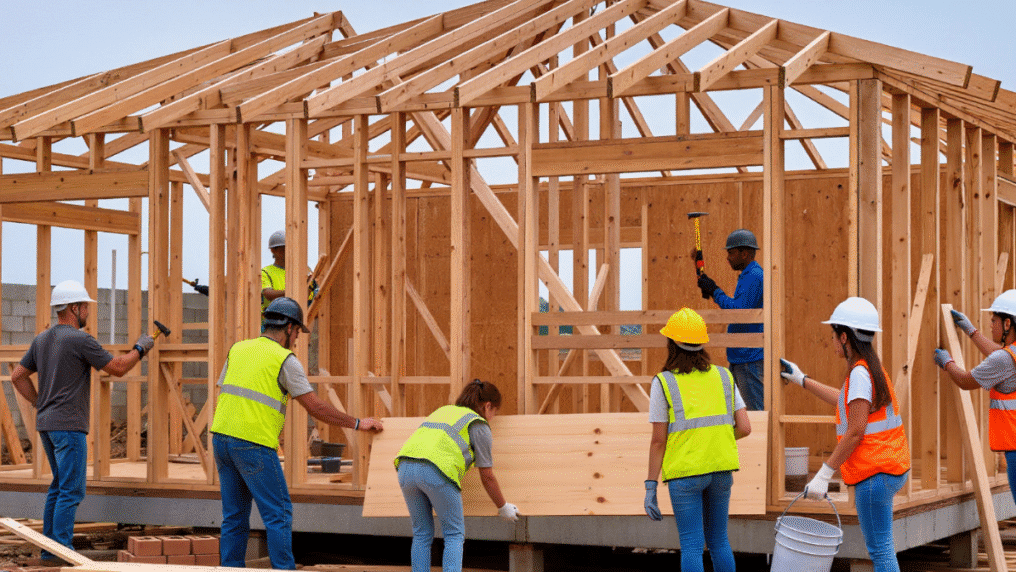
Times (and practices) have changed in the building trade since the early days. The materials and construction methods used have evolved significantly over the centuries.
It is taking the human race from simple cave dwellers to architects of some of the most complex and intelligent structures we’ve ever seen.
We travel back in time to take you on a journey from mud bricks and thatch roofs right up to the cutting-edge materials we use in our new homes in Darlington.
Using Nature’s Best
The earliest shelters used the most natural materials to their advantage. Early Stone Age people used ready-made structures, such as caves and other natural shelters.
These help them to enjoy basic protection from the elements. As the period progressed, builders relied on stone, mud, clay, and wood.
People moved from caves to huts made of wood in search of greater comfort and durability.
The history of building materials tells that stone mounds later became popular, with stone, shells, animal bones, and mud forming the basis of these early homes.
The framed homes we are familiar with today were born much earlier than many think. Wooden-framed roundhouses topped with turf or thatch were considered the height of sophistication during Neolithic times.
Elsewhere, the use of concrete was also taking root, with the earliest concrete structure (a mix of lime, water, and stone) thought to be a hut in Israel dating back to 7000 BC.
From Round To Rectangular
Fast forward to Roman Britain, and the roundhouse began to change its form. The Romans brought rectangular plans to the UK.
The construction of the buildings was more uniform, and streets began to form in cities, while extravagant villas took precedence in the countryside.
With these more complex constructions came a greater range of building materials.
Romans used timber, wattle and daub, stone, and brick to build their residences. Inside, the introduction of plaster created a thermal efficiency that was a societal first.
Clay and stone still played a part, with tiles and slats completing the weatherproof puzzle for buildings that didn’t rely on wooden shingles or thatch.
This mix of building materials was so successful that it was widely used throughout Britain until the 17th century, when a catastrophic event would change practices for good.
A Change Of Heart In 1666
The history of building materials also talks about the damage and devastation of the Great Fire of London in 1666 changed the city in many ways.
With 100,000 people made homeless by the inferno and large parts of the city destroyed, it became clear that the buildings weren’t ideal for fire safety!
It was during the aftermath of the Great Fire that they introduced the very first building regulations. This fixed the fact that all houses and buildings could be built only in brick or stone.
There were some exceptions to this rule, with the reconstruction of Shakespeare’s Globe permitted to be built in the original materials of wood and thatch.
The development of masonry techniques, drawing on the history of building materials, paved the way for larger-scale construction.
This was during the Industrial Revolution and the Victorian era, when mass-produced bricks became the material of choice.
From Post-War Prefabs To The Eco Homes Of Today
The manufacture and prefabrication of building materials for mass housing construction only grew further in the post-war era.
People wanted low-cost solutions, which led to large panels, precast concrete systems, and reinforced high-rises becoming popular.
It wasn’t until the late 20th century in the history of building materials that people began experimenting with materials and methods once more.
These modern materials were developed for thermal performance, and as tumbling energy costs rose, more sustainable materials came into focus.
Environmental considerations now play a vital role in the construction of new homes as well as the renovation of existing dwellings, and many new building materials are available.
From engineered timber and blended, low-carbon concrete to recycled aggregates and smart insulation, the specs of the latest projects are being reshaped with the future in mind.
What Are Some Examples Of Current Eco-Friendly Building Materials That Are Gaining Popularity Today?
Bamboo, hempcrete, recycled steel, and innovative biomaterials like mycelium-based composites are among the most popular eco-friendly building materials today.
The main features of these materials are their reduced environmental impact, energy efficiency, and durability.
The list of current eco-friendly building materials continues with:
Natural And Renewable Materials
Bamboo: An excellent, renewable alternative to traditional timber and even steel in some applications, due to its rapid growth rate (3-5 years) and high strength. Bamboo is used for flooring, wall panels, and structural elements.
Hempcrete: A lightweight, bio-composite material made from the woody core of the hemp plant mixed with a lime-based binder and water.
It is carbon-negative because it absorbs carbon dioxide during curing and thus offers excellent insulation and breathability.
Rammed Earth/Adobe: These ancient techniques apply a mixture of local soil, sand, and gravel to create durable, thermally efficient walls that naturally regulate indoor temperatures.
The use of local materials results in a significant reduction of transportation emissions.
Cork: Cork is a lightweight, fire-retardant, and highly effective thermal and acoustic insulation material used in flooring and wall cladding.
The material is made from the bark of cork oak trees harvested without harming the tree.
Cross-Laminated Timber (CLT): This engineered wood product is created by layering wood panels in alternating directions, resulting in a strong and durable material that can replace steel and concrete in large buildings while storing carbon.
Recycled And Waste-Based Materials
Recycled Steel: The world has steel, one of the most recycled materials, which can be recycled infinitely without losing its strength.
Recycling steel saves 75% of the energy required for new steel production.
Recycled Plastic: Old plastics are converted into composite materials for use in decking, fencing, roofing tiles, and even bricks.
This process not only helps keep plastic waste out of landfills but also lowers the demand for new plastics.
Fly Ash Concrete: Fly ash, a byproduct of coal-fired power plants, is added to concrete as a supplementary material.
Thus, the amount of traditional cement (a major contributor to CO2 and other gas emissions) is reduced, and at the same time, the concrete is made stronger and more durable.
Reclaimed Wood: Picture this- a wood cut for structures, barns, or furniture, the reclaimed wood adds a certain aesthetic character and at the same time reduces the demand for freshly cut timber, thus helping to prevent deforestation.
Innovative and Smart Materials Mycelium Composites: Just like a living organism, mycelium, the root system of mushrooms.
This can be cultivated from agricultural waste into light, fire-resistant, and biodegradable insulation and structural panels.
Self-Healing Concrete: This futuristic material contains either bacteria or sealed polymers.
This becomes active when cracks appear, automatically producing calcium carbonate crystals to close them and consequently prolonging the life of the structure.
Solar Roofing Tiles/Glass: These materials come with photovoltaic cells embedded in the building’s surface.
This means the building can produce its own clean energy while also serving as a functional roof or windows.