By Barsha Bhattacharya
Persuasive language appears in essays, speeches, and even advertisements every day. The goal is to sell a product or a piece of information to the right audience. The concept of persuasion comes from the Greek philosophers. Aristotle taught his students three ways to convince an audience: ethos, pathos, and logos.
Today, writers and marketers use these exact concepts to communicate. Instead of simply giving information, they use specific language techniques to convince readers. However, many students or writers still find it difficult to grasp the concept of persuasive writing. This article will help you understand the concepts of persuasive language writing. Find out more below:
What is Persuasive Language and Why It Matters for Essay Writers & Marketers?
As Purdue University notes, “Persuasive language is the choice of words and rhetorical strategies used to influence an audience’s attitudes or actions by appealing to logic, emotion, and credibility.”
Persuasive language is the concept of changing someone’s mind or provoking an action. This technique differs from informative language, which focuses solely on teaching or explaining a topic with facts. You can test the difference by looking at the speaker’s goal. If your goal is to make the reader say, “I need to act,” you are using persuasion. If you want them to say, “Now I understand,” you are sharing information.
The following are the reasons why most of the writers include persuasive language in their writing:
- They use facts to prove their points. Facts, coupled with emotions, carry more weight.
- Formal register is another way these writers bring in the writing to attract a wide range of audiences.
- Writers change the reality or the perceived reality of a piece of content to help readers understand their point.
The 5 Persuasive Language Tips & Techniques Strong Essay Writers Use
The following section includes persuasive language techniques and tips developed with the help of Dr Bernice Raymond, a top-rated academic writer at The Academic Papers UK, a legit essay help service. Continue reading below to learn about them:
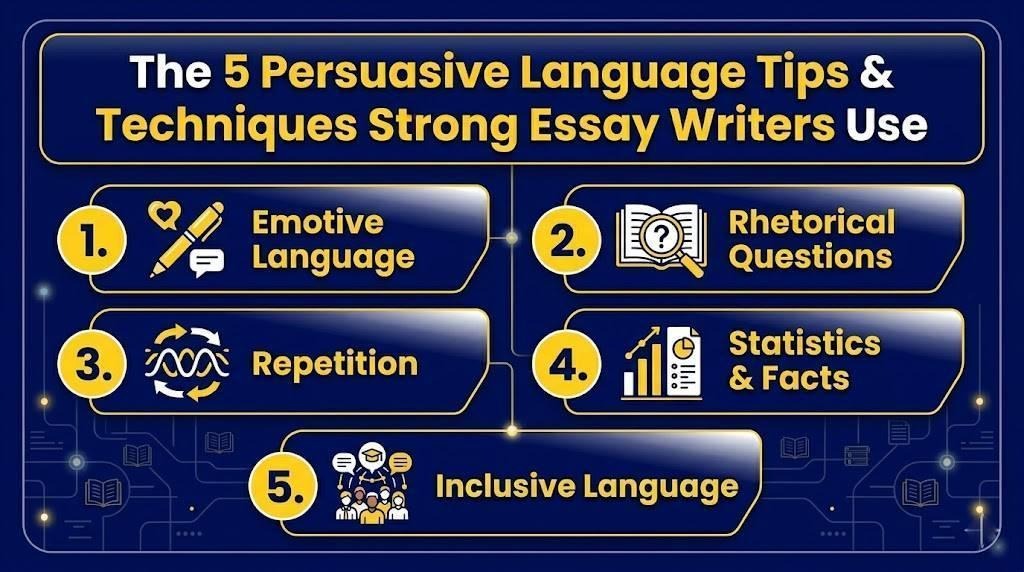
1. Use Emotive Language Writing to Connect Emotionally
Emotive language persuasive writing makes the reader feel something specific. Writers pick words that cause an emotional reaction instead of using neutral words. A quick example would be replacing a weak verb like “was” with a strong verb like “wagged” to show action and convey joy.
Apart from that, you can use sensory words to integrate the five senses to create a mental picture. On top of that, you can also include negative words like “disgusting” or “outrageous” to provoke anger or frustration about an issue.
This evokes empathy and prompts the audience to donate. If you’re looking for practical ways to blend these persuasive language tips into real essay paragraphs, check out this straightforward essay writing guide packed with real examples.
2. Ask Rhetorical Questions to Engage Readers
A rhetorical question is asked to emphasise a point rather than to get an answer. It is used to engage the audience and provoke thought. The writer doesn’t want an answer; they want to evoke emotions or spark interactions with readers. They express frustration well. Asking “Do I look like a bank?” communicates annoyance about spending money without directly stating it. Some persuasive language examples of rhetorical questions in persuasive language writing are:
- Shakespeare used them to point out discrimination. In The Merchant of Venice, the character Shylock asks, “If you prick us, do we not bleed?” to establish his shared humanity.
- Winston Churchill asked, “What kind of people do they think we are?” to rally a besieged nation.
- Greta Thunberg asked, “What kind of world do we want to leave behind?” to force consideration of climate policies in rhetorical questions and persuasive language.
3. Master Repetition Persuasive Technique for Emphasis
Repeating words or phrases helps people remember the main point. Writers use different types of persuasive language repetition to build rhythm in their writing. The process is called anaphora, which is repeating a word or phrase at the beginning of sentences. Martin Luther King Jr. used anaphora when he repeated “I have a dream” in his famous speech.
Here is a breakdown of this persuasive language features with examples:
| Technique | Definition | Example |
| Anaphora | Repeating a word or phrase at the beginning of sentences. | Martin Luther King Jr. repeated, “I have a dream”. |
| Epiphora | Repeating a word or phrase at the end of sentences. | Abraham Lincoln’s phrase “government of the people, by the people, and for the people”. |
| Symploce | Using both anaphora and epiphora at the same time. | “This book is a message. This book is a letter.” |
4. Incorporate Statistics and Facts in Persuasive Writing for Credibility
Logos is the appeal to logic in effective persuasive language. It requires facts and statistics. A good argument needs evidence so the reader trusts the writer. Simply throwing numbers at a reader does not work well. People understand frequencies better than percentages.
Saying “2 out of 100” is easier for the human brain to process than “2%”. A study at Harvard Medical School showed that people made better decisions when they received information in the form of frequencies instead of probabilities. Writers frame data around losses or gains to change how the audience reacts. Pointing out a potential loss gets more attention than pointing out a gain.
5. Apply Inclusive Language Persuasion to Build Rapport
Inclusive language persuasion helps writers build trust with their audience. It shows respect for different people and backgrounds. When an audience feels respected, they are more open to listening to an argument. The American Psychological Association released guidelines to support the use of culturally sensitive terms. And now Generation Z is on track to become the most diverse generation in history.
Hence, using “we” or “our” creates a sense of shared responsibility. Plus, using the word “you” shifts the focus onto the reader. Replacing assumptive phrases prevents readers who lack the prerequisite knowledge from feeling inadequate.
How to Use Persuasive Language with Professional Guidance?
Even if you learn the tips mentioned above, sometimes it can be hard to use persuasive language well on your own. Experts can guide you and make your writing stronger. They know how to pick the right words and structure your essay so your ideas really stand out. Getting help from professional essay writing services can save time and give you confidence in your work. Here are some ways experts can help:
- Show you how to use emotive language to connect with your readers.
- Help you craft rhetorical questions that make your points clear.
- Teach you repetition techniques to make your main ideas memorable.
- Explain how to include stats and facts for credibility.
- Suggest inclusive language that makes everyone feel included.
Review your writing and give tips to improve clarity and impact.
Conclusion
Persuasive language helps you get people to understand your point and agree with you. You can do this by using feelings, asking questions, repeating important words, sharing facts, and including everyone in your writing. When you use these tips, your essays, speeches, or stories become stronger and easier for others to follow.
Some common persuasive language strategies include:
- Use of emotional tone.
- Ask rhetorical questions.
- Master repetition for emphasis.
- Include stats and factors
- Apply inclusive language to build rapport.
Frequently Asked Questions About Persuasive Language
Persuasive language is not a specific spoken language like Spanish or French. It is a style of writing or speaking used to convince people. Writers use different registers depending on who they are talking to. A register is a variety of languages associated with a particular situation.
Persuasive language in advertising often uses 12 magic words: you, money, save, new, results, health, easy, safety, love, discovery, proven, and guarantee. Many people claim this list came from a psychology study at Yale University. Later, direct marketer Dick Benson suggested adding the word “free” to the list.
Persuasive language is communication that tries to get someone to agree with an opinion or take a specific action. It goes beyond sharing facts. It uses tools such as emotional appeals, logical arguments, and rhythmic sentence structures to influence how readers think and feel. You use persuasion to make people act.